
“Come to my office when you’re ready. Here’s my card. Don’t discuss this with your parents before we talk.”
They were in their car and pulling away before I could form a second question.
I stood on the porch holding the folder. It was heavier than it looked, maybe 40 pages. The seal had been signed across the flap in Lorraine’s handwriting, looping and deliberate, the way she signed birthday cards and Christmas checks.
My phone buzzed. A text from Diane.
Who is at the door? Don’t sign anything, Nora.
I turned the phone face down and brought the folder inside. I sat at the kitchen table, the same table where the birthday cake had sat untouched the night before, and ran my finger along the sealed flap.
Lorraine’s signature crossed the seal. I recognized every curve. The capital L with its exaggerated tail, the double loop on the lowercase R. This wasn’t a shaky mark. This was written by a woman who knew exactly what she was putting her name on.
I broke the seal.
Inside, a stack of legal documents I recognized from work. A recorded deed, a trust instrument, a durable power of attorney, notarized witness pages, a physician’s letter on medical letterhead dated 14 months ago.
Clipped to the front was a handwritten note on Lorraine’s personal stationery, cream paper, blue ink, the same deliberate script.
Nora, when they come for the house, open this. Everything you need is here. I love you. I’m sorry. It has to be you.
I read the note three times. Each time the words when they come for the house landed harder.
Not if. When.
She’d known. 14 months ago, before the forgetting got bad. Before she started calling me by my mother’s name, before the wandering and the stove left on, and the day she got lost driving to the post office two blocks away.
She’d known someone would come for the house. She’d prepared.
I closed the folder and pressed my palm flat on top of it. Through the doorway, I could hear Lorraine snoring lightly in her recliner, a crossword puzzle slipping off her lap.
She’d hired a lawyer. She’d signed documents. She’d left me instructions.
That note didn’t let me sleep that night. I lay in the guest room with the folder on the nightstand, watching the ceiling, listening to the house breathe.
Monday morning, I called in sick to work for the first time in 3 years. Something in me said to stay.
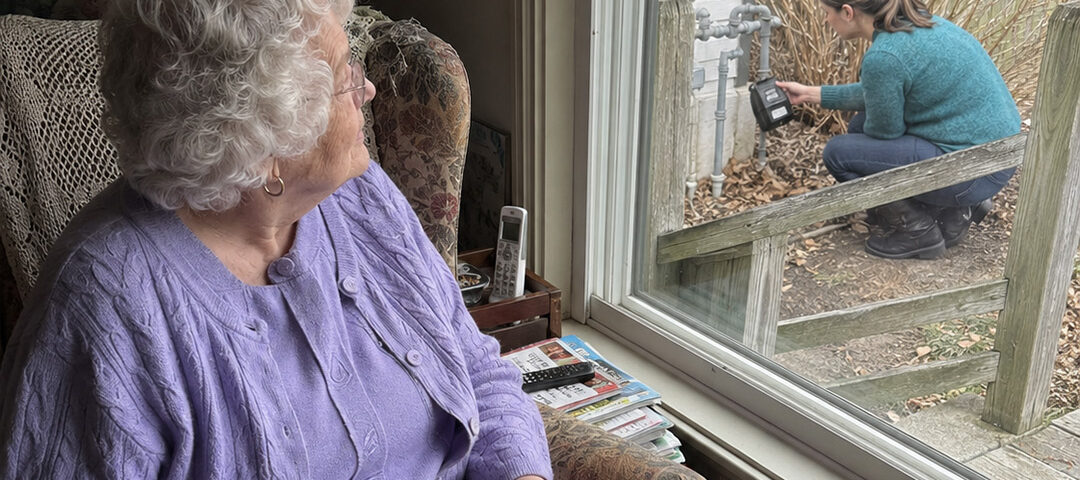
I found it while taking out the recycling. A lockbox. A realtor’s combination lockbox clamped to the gas meter behind the hydrangea bushes, tucked just out of sight from the front walk.
I knew what it was immediately. I’d seen them on every listing in Brierwood. Somebody had been showing this house.
I went back inside and opened Lorraine’s mail pile. Three weeks of unsorted envelopes on the hallway table, buried between a phone bill and a coupon flyer.
I found a listing sheet, off-market, printed on Voss and Dean Realty letterhead. The same Brenda Voss from the business card behind the photo frame. Four bedrooms, 2 and a half baths, original hardwood, quarter-acre lot, listed at $680,000, $50,000 under the most recent comp in the neighborhood.
In the kitchen junk drawer, I found the worst of it.
A purchase agreement, unsigned, but filled in. Buyer: Stonewall Capital Group, LLC. Cash offer. 30-day close.
Seller’s signature line left blank, but someone had penciled L. Caldwell in block letters below it, like a rehearsal.
The listing agent was Brenda Voss. The contact on the buyer’s side was a name I didn’t recognize, but the seller’s representative listed on the agreement was Aaron Caldwell, my brother.
I sat on the kitchen floor and spread the pages around me like a paper mosaic: the lockbox, the listing sheet, the purchase agreement, Brenda’s card, a sticky note in Diane’s handwriting.
Closing target: November 15th.
That was 3 weeks away.
I picked up the folder from the nightstand, and this time I opened it to the first page of the trust instrument. I read every word.
I called my mother at 6:00 that evening.
“Oh, Nora.” Diane’s voice had that specific warmth, the one she used on parish volunteers and restaurant hostesses. Bright. Managing. “How’s Gran doing? We had the most wonderful time in Aspen. The snow was just divine.”
“There’s a lockbox on her gas meter.”
Silence. 2 seconds. Three.
“Sweetheart, that’s being handled. Dad and Aaron have been working with a lovely agent to find a suitable transition plan for your grandmother. You know she can’t keep up this big house on her own.”
“There’s a purchase agreement in her kitchen drawer.”
“Nora.”
The warmth dropped one register.
“This is a family decision between your father, your brother, and me. We’ve been managing Gran’s affairs for months. You don’t need to worry about the details.”
“She doesn’t know the house is being sold, does she?”
“She knows what she needs to know.”
Diane paused. I could hear the clink of a wine glass.
“Aaron’s company is in a difficult stretch. The house can fund a proper care facility for Gran and help your brother through a rough patch. It’s the responsible thing.”
“It’s her house, Mom.”
“Nora.”
The register dropped again. All the way to the basement. Cold. Final.
“Your grandmother has dementia. She leaves the stove on. She got lost driving to the post office. She is not the person who should be making decisions about a $680,000 asset.”
Then she said it.
“She won’t remember the house by Christmas.”
The line hummed between us.
“Then it’s a good thing I remember,” I said.
I hung up. I picked up the manila folder and Ruth Adler’s business card. I held them side by side under the kitchen light.
Tomorrow I would drive to Hartford. Tonight, I had reading to do.
Ruth Adler’s office was on the second floor of a converted brownstone on Asylum Avenue. The waiting room had faded oriental rugs, framed diplomas from UConn Law, and a small brass sign that read Adler and Associates, Elder Law and Estate Planning.
I’d called at 7:30 that morning. Her receptionist put me through in under a minute, which if you know anything about law offices tells you they were expecting the call.
“Miss Caldwell.” Ruth’s voice was the same measured calm from the porch. “I’m glad you reached out. Can you come in today?”
I drove the 3 hours again.
Ruth met me in a conference room with a pot of Earl Grey and a box of tissues she placed exactly between us on the table without comment.
“Your grandmother came to me 14 months ago,” she began. “Early August of last year. She’d had an episode, got disoriented driving, ended up two towns over, couldn’t remember how to get home. A neighbor brought her back. She called me the next morning.”
“She already knew you?”
“She knew my firm. Her friend Dorothy had used us for a trust. Your grandmother came in alone. She was sharp, focused.”
Ruth paused.
“Scared.”
“Of what?”
“Of exactly what’s happening now.”
Ruth folded her hands.
“She told me, ‘My son will do whatever Diane tells him, and Diane will sell the house the minute I can’t stop her.’ She wanted to stop it before she couldn’t.”
I put my tea down.
“She chose you, Miss Caldwell, specifically. She said, ‘You were the only one who would fight for the house because you were the only one who understood what it meant.’”
Ruth opened her own copy of the folder.
“Your grandmother prepared for this. Let me show you how.”
Ruth walked me through it piece by piece.
14 months ago, August of last year, Lorraine had come to this office wearing pressed slacks and her pearl earrings, carrying a folder of her own: deed to the house, tax records, her will from 1998. A list of questions she’d handwritten on yellow legal pad paper in the same looping blue ink I’d seen on the note.
“She was methodical,” Ruth said. “She told me she’d noticed the forgetting. Names first, then appointments, then the route to the post office. She said her doctor had used the word early stage. She said she had maybe a year, maybe two before the window closed.”
“The window for what?”
“For making legally binding decisions while she still had capacity.”
Ruth turned to the page.
“She wanted two things. First, to protect the house. Second, to choose who would protect her when she couldn’t protect herself.”
“And she didn’t choose my father.”
Ruth looked at me over her reading glasses.
“No, she did not.”
Continued on next page
