
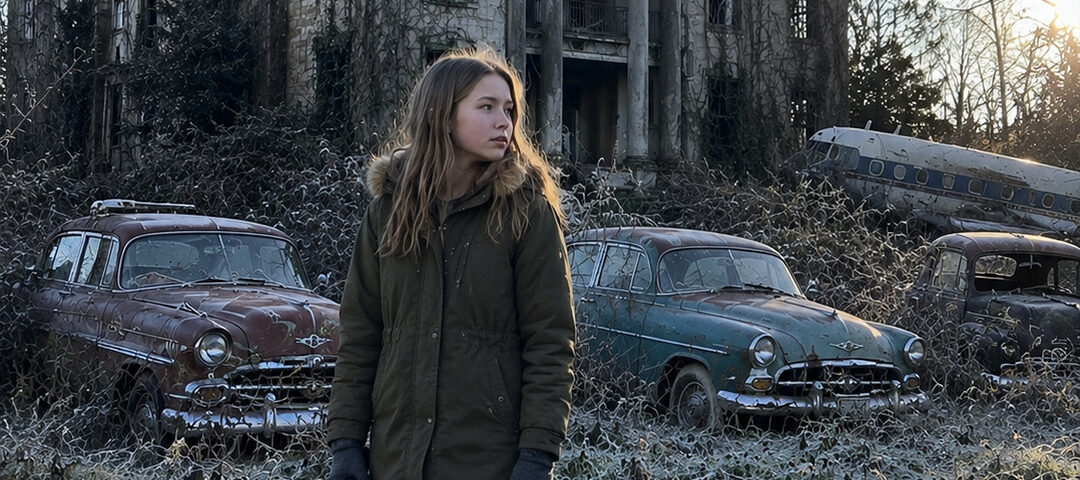
The mansion was larger than the photograph had suggested.
Even damaged, even half-swallowed by vines, it had presence. The stone arches over the windows were elegant, the front steps wide and formal beneath the weeds. A cracked fountain sat in the center of what had once been a circular drive. Wind moved through the empty windows and made the house seem to breathe.
Then there were the cars.
Eleven of them, scattered across the land like pieces of a story interrupted. A rounded sedan from the forties, rusted deep red. A pale blue Chevrolet with one door open and rainwater collected in the floorboard. A delivery truck with faded lettering I could no longer read. A long black car under a sycamore tree, its hood lifted like a question. Three vehicles so weathered that I could only guess what they had once been. And near the back field, past a line of wild shrubs, the two planes rested with their noses slightly down, as if they had been waiting decades for permission to leave.
The old man arrived in a beige sedan that looked nearly as tired as he did. He wore a wool coat, polished shoes, and carried a leather key ring darkened by age.
“Henry Vale,” he said.
“Mara Ellis.”
His eyes flicked to my suitcase but he did not comment. For that alone, I liked him.
He unlocked the gate. The hinges complained but moved. We walked up what had once been a formal garden, past stone planters cracked open by roots. Henry showed me the house without drama. A grand front room with part of the ceiling gone. A kitchen with an old iron stove and a single pot still sitting on top. A dining room with dusty cabinets and broken glass glittering on the floor. Two bathrooms that needed more courage than plumbing. A library with empty shelves, a stopped pendulum clock, and wallpaper peeling in long strips like old skin.
Upstairs were three bedrooms. Two were unsafe. The third had a wall still solid enough to block the wind.
Henry did not tell stories. He did not explain the cars. He did not explain the planes. He simply pointed out rot, cracks, water damage, and a place where the floor dipped too much to trust.
“This property is a burden,” he said when we returned to the front room. “Taxes, liability, complaints from people who like to complain about things they never intend to fix.”
“Why sell it for so little?”
He looked at the broken windows. “Because everyone who could afford to restore it wants to erase it first.”
I understood that better than he knew.
He handed me a yellowed folder. Inside were the deed papers, tax receipts, photographs, and a simple sale agreement. Sold as-is, with all contents, fixtures, outbuildings, vehicles, stored materials, and remaining personal property included unless otherwise excluded in writing. Nothing was excluded.
“You should have a lawyer review it,” Henry said.
“I can’t afford one.”
“I figured.”
“That means you could cheat me.”
His mouth twitched, almost a smile. “Yes.”
“Are you?”
“No.”
I looked at him for a long moment. He held my gaze without flinching. In the silence, wind moved through the house and lifted dust from the floor. A square of winter sunlight fell across the cracked boards between us.
“I want it,” I said.
Henry closed his eyes briefly, not in surprise. In relief.
We signed at a small county office two hours later. My savings became a cashier’s check. My hand shook when I wrote my name. Henry gave me the keys on the sidewalk afterward, three heavy brass ones and a smaller iron key tied together with a strip of old leather.
“Whatever you find there,” he said, “go slow.”
I almost asked what he meant.
But the ad had said no questions.
The first night in the mansion, I slept in my coat on a blanket spread across a corner of the front room I had swept three times. There was no electricity. No running water worth trusting. No heat except what my body could make under two blankets and every sweater I owned. The smell hit me hardest: damp wood, old plaster, mouse droppings, mildew, soil, and something beneath all of it that was not rotten exactly. It was time. Time closed in a house for decades. Time soaking into curtains, floorboards, books, and wallpaper until everything smelled like memory with nowhere to go.
I woke every hour. Wind moved through the broken windows. Branches scraped the siding. Somewhere in the walls, something small shifted and went still. I was not afraid of ghosts. I was afraid of the roof giving way. I was afraid of getting sick. I was afraid of Greg being right when he called me impractical without ever using the word.
At sunrise, light came through the empty windows and touched the floor in long pale strips.
I sat up, cold and stiff, and said out loud, “This is mine.”
My voice echoed back at me.
That was enough.
The first week became a rhythm of survival. I worked morning shifts at the grocery store, took the bus back as far as it went, walked the rest, and cleaned until my hands cracked. I cleared glass from the kitchen. I dragged ruined curtains outside. I found an old broom in a pantry and used it until the bristles fell apart. I bought a camping lantern, two jugs of water, contractor bags, and a cheap padlock from the hardware store. Every purchase hurt because money had become a clock ticking in my pocket.
Still, the house gave me things back.
Under dust and mildew, there was furniture made to last: a carved dining table too heavy for me to move, a writing desk with brass handles, a bedroom dresser whose drawers still slid smoothly after all those years. In the library, the stopped clock ticked once when I cleaned around the pendulum, a single dry sound that made me laugh so suddenly I had to sit down.
I learned the safe path through the house. Avoid the east side upstairs. Step over the third stair. Do not lean on the railing near the landing. Sleep in the back room on windy nights. Open the front doors for ventilation when the sun warmed the stone. Keep my phone charged at work because the mansion could not do that yet.
On the fourth day, while prying up a section of warped flooring in the back parlor, I found the trapdoor.
My boot pressed a board that moved differently. Not rotten. Hinged.
I knelt, brushed dirt and splinters aside, and found an iron ring set flush into the wood. For a while, I simply stared at it. The house seemed to quiet around me. Even the wind paused.
Val’s flashlight sat on the floor beside my knee. I picked it up, held the ring, and pulled.
The trapdoor opened with a long dry groan.
Dust rose in a soft cloud. Beneath it, a narrow staircase descended into darkness. Eight wooden steps, steep and deliberate, leading below the house.
I should have waited. I should have called someone. I should have remembered every warning people had left under that Facebook photo.
Instead, I turned on the flashlight and went down.
The air below was cooler and strangely clean compared with the rooms above. The walls were stone, fitted tightly, rising to a dark wooden ceiling. My flashlight moved across the room, and the beam found faces.
I froze.
Paintings covered the walls.
Not decorations. Not amateur sketches. Paintings. Large canvases, framed and unframed, some hanging, some leaning in careful rows, some wrapped in cloth that had yellowed with age. Faces emerged from shadow with eyes so alive that my breath caught. Landscapes opened into impossible depth. A woman in a green dress stood beside a window with one hand pressed to the glass, her expression so private I felt rude looking at her. Two airplanes flew low over a field under an orange sky. A child sat on a kitchen floor beside a cracked bowl, light falling across her hair like a blessing.
There were dozens. Maybe more than a hundred.
In the center of the room stood a long worktable covered with hardened brushes, glass jars, old tubes of paint, wooden palettes crusted in layers of color, notebooks, letters tied with ribbon, and newspaper clippings in languages I did not recognize at first. Everything had been arranged with care. Not abandoned. Protected.
I sat down on the packed-earth floor with the flashlight in my lap and began to cry.
Not because I was scared. Not because I was suddenly rich, because I did not know anything about value then. I cried because the room felt like proof that a life could be hidden and still matter. Someone had made all of this in silence. Someone had poured years into beauty no one saw. Someone had left evidence that they had been here.
I thought of the bus stop. The blue door. My mother’s back at the kitchen sink.
For the first time since leaving home, I felt something other than survival.
I felt called.
The first notebook had a leather cover cracked at the spine. I opened it with both hands, afraid the pages might break. The handwriting inside was small, slanted, and precise.
Elena Vargas.
April 12, 1948.
I whispered the name into the room.
Over the next several weeks, I built my life around the eight steps. Work, bus, walk, clean, eat, read. Work, bus, walk, clean, read. I learned to wash my hands before touching the notebooks. I learned to set each letter back exactly where I found it. I used my phone to photograph pages in case the paper became too fragile. At night, I sat wrapped in a blanket with the lantern beside me while Elena’s words opened a second house beneath the first.
Elena Vargas had been born in 1912 to a family that crossed an ocean with very little and built a life through work, restraint, and stubborn hope. Her father repaired engines before becoming a builder. Her mother sewed dresses for women who rarely learned her first name. Elena grew up between languages, between expectations, between the practical world of rent and food and the private world of color that lived behind her eyes.
From the time she was young, she drew on anything she could find: grocery paper, cardboard, the blank backs of church flyers, margins of newspapers. Her father thought art was a childhood habit she would outgrow. Her mother secretly saved coins to buy pencils.
In her twenties, Elena earned a scholarship through a cultural association and studied abroad for several years. She wrote about museums, cold studios, bread eaten in train stations, teachers who smelled of tobacco and turpentine, and the strange relief of being among people who did not ask why she needed to make things. She returned older than her age, carrying skill, longing, and a sadness she never explained plainly.
She bought land outside a small county town and designed a house with impossible care.
Or so I thought at first.
Continued on next page:
