
Not dramatically. Not enough for strangers to notice. But I had spent four years studying small changes in his expression so I could survive dinner. I saw it.
“You don’t get to call it family after you called it money,” I said.
My mother’s hand went to her mouth.
“Mara,” she whispered.
I turned to her, and the anger I expected did not arrive. Only sadness. Bigger, older, quieter.
“You had seven days to choose me,” I said. “I waited on the porch. I waited at the bus stop. I waited every time my phone lit up. You don’t get to come now and stand beside what I saved.”
She began to cry then, but softly, the way she did everything that mattered too late.
Greg looked around, embarrassed by her tears.
That told me all I needed to know.
I walked away with Nora beside me, the binder against my chest, Elena’s letter inside it like a second spine.
The months that followed were the hardest and most beautiful of my life.
The historic designation brought attention, and attention brought resources when handled carefully. A preservation foundation funded emergency climate control for the studio. A major museum offered a temporary loan fee for a small traveling exhibition of selected works, enough to repair the mansion’s roof without selling a single painting. Briar State University began cataloging the notebooks and letters. Every canvas was photographed, measured, documented, and stabilized.
I went back to school.
Not full-time at first. One evening class. Then two. Art history, archival methods, writing. I was terrified the first night I walked into a classroom again. Everyone seemed cleaner, younger, more certain. I sat in the back with a notebook open and my hands cold.
Then the professor began talking about how objects carry memory.
I knew that. Better than anyone in the room.
The mansion changed too, but not into something new. That mattered to me. Don Aurelio restored the roof with materials that respected the original lines. We saved the stone facade. We kept the irregular stairs Rodrigo had designed so no one could rush into Elena’s studio without paying attention. We repaired the library shelves instead of replacing them. The iron stove stayed in the kitchen, cleaned and honored. The stopped clock ticked again after a clockmaker from two towns over spent three afternoons with it and charged me half his usual rate because, he said, “Some houses deserve sound.”
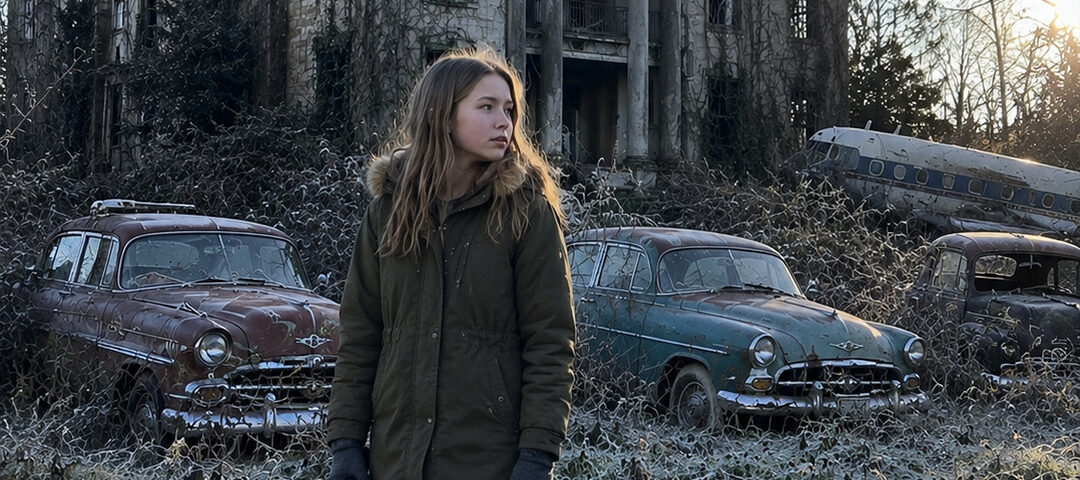
The cars remained outside.
People argued about that. Some wanted them removed. Some wanted them restored. Some wanted them displayed neatly with plaques. But I could not bring myself to line them up like museum props. Rodrigo had left them where life had stopped. The rust, the moss, the trees growing through them—all of it had become part of the record. We cleared around them, stabilized what could be stabilized, and placed low wooden markers nearby with simple descriptions.
The two planes stayed in the back field.
The smaller one, Clara, still leaned slightly to the left. Saint June remained half sunk into the earth, her wings weathered but proud. In late afternoon light, they looked less abandoned than waiting.
A year after the hearing, we opened the studio to visitors for the first time.
Only twelve people at a time. No flash photography. No touching. No loud voices. Everyone descended the eight steps slowly because there was no other way to do it. Dr. Whitaker read passages from Elena’s notebooks while people stood among the paintings. Some cried. Some took notes. Some simply stared.
I stood near the worktable and watched their faces.
For decades, Elena had kept the world out because she feared what it would do to the work. I understood that fear. But watching people stand quietly in that room, not consuming, not grabbing, not turning her into a price tag, I felt something loosen.
Maybe being seen did not always mean being taken.
On Saturdays, the old carriage shed became a free art workshop for local kids.
That was the part I loved most.
Students from the university volunteered. The preservation foundation paid for supplies. Kids arrived with backpacks, shy smiles, loud sneakers, and hands that did not yet know what they could make. Some came from homes full of support. Some came from homes where art was considered a waste of time. I recognized those kids first. They held pencils like contraband.
I told them the same thing every week.
“Use the good paper.”
At first they laughed, but I meant it. Too many people grow up thinking good materials are for someone else, that beauty should be saved for a future version of themselves who has earned it. Elena’s life had taught me otherwise. So had mine.
One Saturday in October, my mother came to the mansion.
She called first. That mattered.
“I’d like to see it,” she said. Her voice shook. “Only if you’re comfortable.”
Greg was gone by then. She did not tell me the whole story, and I did not ask for it. I had learned that not every ending needed a report.
When she arrived, she brought a lemon pound cake wrapped in foil. It was the kind she used to make when I was little, before grief and bills and Greg had narrowed her into someone I could barely reach. She stood at the front gate, looking at the restored stone, the cleared path, the cars resting under autumn leaves.
“I didn’t imagine it like this,” she said.
“Neither did I.”
We walked through the house slowly. She touched nothing without asking. In the library, the clock ticked steadily. In the kitchen, sunlight lay across the iron stove. At the trapdoor, she stopped.
“This was under the floor?”
“Yes.”
She looked at the eight steps. “May I?”
I nodded.
She went down ahead of me, one hand on the railing Don Aurelio had forged because he refused to put aluminum on old wood. At the bottom, she stood in the studio and covered her mouth.
Elena’s paintings surrounded her. The woman in green. The child by the bowl. The planes at sunset. The field without engines. The self-portrait Elena had painted late in life, her face lined, her eyes steady, one hand stained with blue.
My mother turned slowly, taking it in.
Finally she said, “You protected all this.”
I stood beside the worktable. “I tried.”
She looked at me then with tears in her eyes. “I didn’t protect you.”
The words did not fix anything.
But they were true.
For a long time, that was all I had wanted from her. Not excuses. Not explanations about pressure or marriage or how hard things had been. Just the sentence with its face uncovered.
“No,” I said. “You didn’t.”
She nodded, accepting it. That acceptance did more than her tears.
“I am sorry,” she said.
I looked at Elena’s self-portrait. I thought of Rodrigo leaving to keep trouble from her door. I thought of my mother closing one. I thought of all the ways love can fail when fear is louder.
“I believe you,” I said.
I did not say it was okay. It was not. But believing her apology was a door I could open without moving back inside the old house.
Before she left, I showed her the plaque outside the carriage shed. The words had been carved into dark wood from one of the fallen beams we could not reuse.
The most abandoned place in the world can become the most alive, if someone decides to stay.
My mother read it twice.
Then she touched the edge of the plaque with two fingers and whispered, “Your grandmother would have loved this.”
That almost broke me.
That evening, after she drove away, I walked to the back field where the planes rested. The sun was low, turning the grass gold around the old wheels. The eleven cars sat in their places, each one marked by time, each one still belonging to the story. A breeze moved through the broken cabin of the blue Chevrolet. Somewhere near the carriage shed, children’s laughter from the afternoon seemed to linger in the air.
I stood beside Clara and placed my hand lightly on the weathered metal.
At eighteen, I had thought I needed a house because I had nowhere to sleep. I did not know I was looking for a place that understood abandonment without surrendering to it. I did not know a ruined mansion could teach me the difference between being unwanted and being unfinished. I did not know that under broken boards, behind dust and silence, there could be a room full of proof that someone’s hidden life still mattered.
I had arrived with a broken suitcase, sixteen dollars in cash, and the belief that my mother’s closed door had defined the size of my future.
Now the mansion had a roof that held through rain. The studio breathed in careful light. Elena’s paintings had names, records, witnesses. Kids painted every Saturday in a building that once stored rusted tools. My own name appeared on documents not as current occupant, not as distressed purchaser, not as someone in my position, but as steward.
I still kept the green suitcase.
It sat in my bedroom at the foot of the bed, scuffed and ugly, one wheel missing. People asked why I did not throw it away now that I could afford better. I always said the same thing.
“Because it got me here.”
The mansion nobody wanted had become the place people came to learn how much value can hide inside what the world dismisses. The cars and planes remained outside, not as wreckage, but as witnesses. Rodrigo’s final letter rested in the archive, his promise preserved even if he never returned to fulfill it. Elena’s notebooks sat in climate-controlled drawers, but her words lived on the plaque where children passed every Saturday with paint on their fingers and possibility in their faces.
Sometimes, when visitors leave and the house settles into evening, I walk through the front room and remember the first night I slept there in my coat, afraid of every sound. I remember the blue door closing. I remember my mother’s silence. I remember the bus stop, the broken wheel, the ad in the paper, Henry’s old keys in my palm.
Then I open the trapdoor and descend the eight uneven steps.
Slowly.
With intention.
Because Rodrigo was right. Some rooms should not be entered in a hurry.
At the bottom, surrounded by Elena’s paintings, I stand in the quiet and understand what I could not have understood at eighteen: being forced out was not the end of my story. It was the moment I stopped begging for a place in someone else’s house and found the courage to stay in a place everyone else had abandoned.
And every time the wind moves over the back field and the old planes seem to listen, I think the same thing.
The world can close a door in your face.
But sometimes, if you keep walking, you find a whole mansion waiting under the weeds.
