
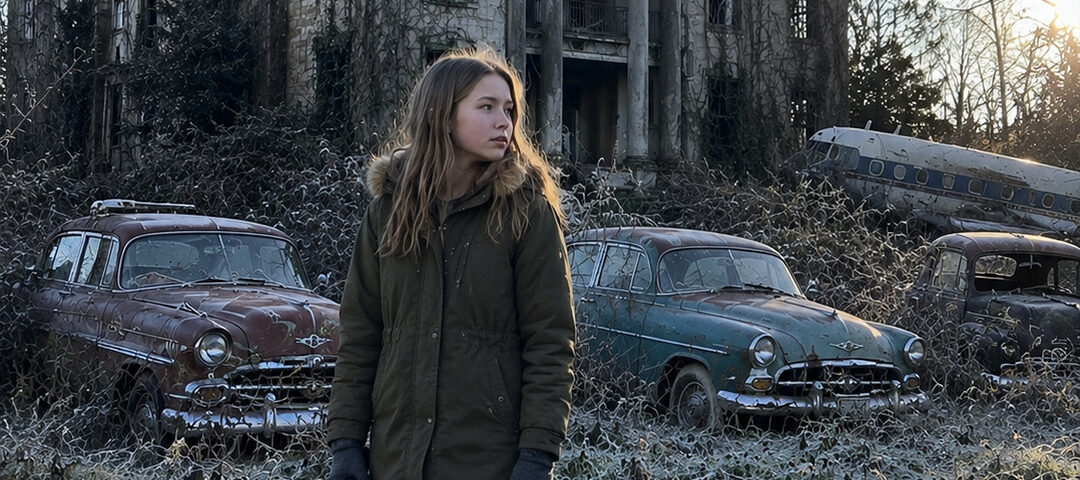
The notebooks described the windows, the light, the stone, the hidden studio beneath the parlor. I believed Elena had built the mansion for herself until I found the locked drawer in the library desk. The smallest iron key on Henry’s ring opened it.
Inside were letters.
Rodrigo Mendoza wrote like a man who did not waste words because he trusted them to carry weight.
Elena,
The mason thinks I am unreasonable about the lower room, but I told him the temperature matters. Stone walls, packed floor, no direct light unless you ask for it. Eight steps, as you said. Not seven. Not nine. Eight. You were very firm about that. I hope when you go down them for the first time, you understand I was listening.
I read the letter three times before I understood.
Rodrigo had built the mansion for her.
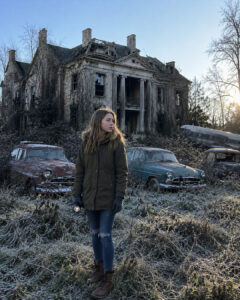
He was a civilian pilot, a mechanic, a man who loved engines the way Elena loved paint. He owned the planes in the field and most of the cars scattered across the property. He had money once, or access to it, though the letters made clear he cared more about machines than appearances. The cars were not trophies. They were chapters. A sedan driven through three states to bring Elena a crate of canvases. A truck used to haul stone for the house. A roadster that broke down so often Elena teased him it was less a vehicle than a relationship.
Their love story did not unfold like the ones people write in cards. It unfolded in repairs, letters, cups of coffee left on windowsills, weather reports, and the sound of a plane engine passing low over the fields. When Elena hung a white cloth from the garden post, Rodrigo knew he could land. When she wanted to be alone, she hung nothing, and he stayed away.
He understood boundaries. That made me trust him across time.
The two planes in the back field had names painted near the doors, barely visible under moss and peeling paint. The smaller one was Clara. The larger was Saint June. I found both names in Rodrigo’s letters, always written with affection, as if they were old horses with moods.
By then I had stopped thinking of the mansion as mine in the simple sense. Legally, yes. The deed was in my name. But the house had belonged to a devotion larger than ownership. I felt less like a buyer and more like someone who had been handed a room full of sleeping witnesses and told not to wake them carelessly.
Then I found Rodrigo’s final letter.
It was taped to the back of the large painting of the two planes, hidden beneath old brown paper. The envelope had Elena’s name on it. His handwriting, usually steady, wandered in places.
He wrote that certain choices from his past were drawing attention he could not risk bringing to her door. Years earlier, he had used his routes to help families travel quietly when paperwork and timing stood between them and safety. He did not describe it dramatically. Rodrigo did not seem like a man who made himself the hero of his own story. He only wrote that he had done what let him sleep at night, and now there were questions from people with clipboards, questions that could reach Elena’s studio if he stayed.
He left the planes because moving them would invite more questions. He left the cars because they belonged to the property. He left the house because it was never truly his.
The last line made me sit down on the studio floor.
You asked once what it feels like to be in the air. I did not know how to answer. Now I think it is the same feeling I have when I stand in the middle of your paintings: for a moment, I am exactly where I am supposed to be. Guard the room. Guard the work. I will come back when I can.
He never did.
Elena’s later notebooks became shorter after that. She did not write grief in large, obvious ways. She wrote it through weather. Through the silence after engines stopped passing overhead. Through the extra cup she no longer set out. Through paintings of empty fields, grounded planes, and rooms with doors half open.
She lived in the mansion for two more years, maybe three. The records grew thin. The final notebook ended with a sentence I later had carved into a wooden plaque.
The most abandoned place in the world can become the most alive, if someone decides to stay.
I closed that notebook and held it against my chest.
By then the mansion was not only shelter. It was a responsibility.
I called the art department at Briar State University on a Monday morning from the grocery store break room. I expected to be dismissed. Instead, a professor named Dr. June Whitaker called me back an hour later and asked careful questions.
“You found how many works?”
“I haven’t counted all of them.”
“And the artist’s name?”
“Elena Vargas.”
The line went quiet.
“Did you say Elena Vargas?”
“Yes.”
“Do not move anything,” she said. “Do not let anyone else move anything. May I come see it?”
She arrived two days later in a navy coat and practical boots, carrying a canvas tote and a notebook. Her gray hair was clipped at the back of her head. She looked like someone who had spent her life learning how to be excited without causing damage.
When I lifted the trapdoor and showed her the stairs, she inhaled sharply but said nothing.
At the bottom, I turned on the battery lights I had arranged around the studio.
Dr. Whitaker stood still for nearly ten minutes.
She walked from painting to painting with one hand pressed lightly against her chest, not touching anything. She bent close to examine signatures. She stepped back. She whispered dates under her breath. At one large canvas, her eyes filled.
Finally she turned to me.
“Mara,” she said, and my name sounded different in her mouth. Not like a problem. Like a person standing at the edge of history. “Do you understand what you have here?”
“No.”
“Elena Vargas was one of the most gifted painters of her generation. She was known in certain circles, but she refused public exhibition after the early fifties. Scholars argued for decades about what happened to her work. Some believed it had been destroyed. Some thought it had been sold privately. Nobody knew there was a complete body of work still intact.”
I looked around the room. My eyes landed on the jars of hardened brushes, the tied letters, the painting of the woman by the window.
“How complete?” I asked.
Dr. Whitaker’s voice lowered. “Possibly the most important private collection of mid-century American art to surface in decades.”
I should have felt joy.
Instead, fear moved through me.
Val had once told me that when life hands you something valuable, people appear to explain why it belongs to them. I thought she was being cynical. Three weeks after Dr. Whitaker’s visit, I learned she was being practical.
The first letter arrived in a cream envelope with a law firm’s name embossed across the top. It was addressed to Mara Ellis, current occupant, Hollow Creek property.
Current occupant.
Continued on next page:
